
Civil Surveyor Course in Rawalpindi Pakistan
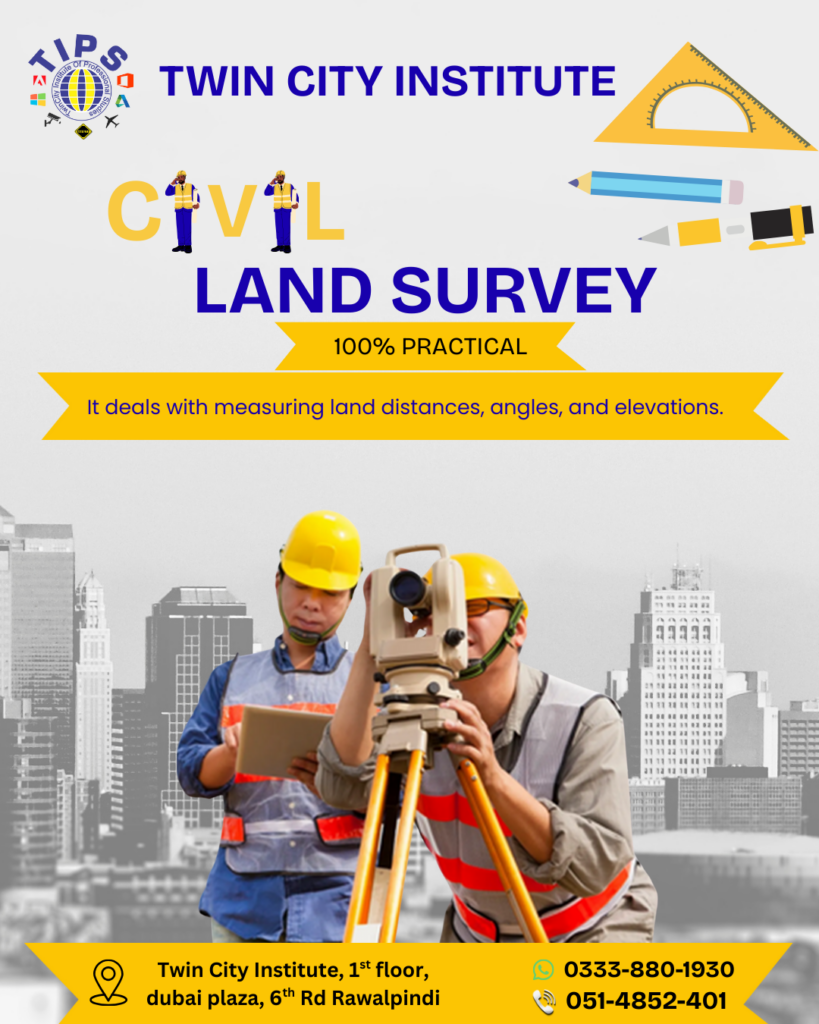
Course Outline:
Introduction to Civil Land Surveying
Overview of land surveying, its importance in civil engineering projects, types of surveys, roles of a land surveyor, and career opportunities in the surveying field.
Surveying Instruments & Equipment
Detailed study of traditional and modern surveying instruments including chains, tapes, compasses, levels, theodolites, total stations, and GPS/GNSS equipment, along with handling and safety practices.
Measurements & Survey Calculations
Linear and angular measurements, units and conversions, error types, accuracy, precision, and adjustment of errors in surveying work.
Land Surveyor Course in Rawalpindi Pakistan
Chain & Tape Surveying
Principles, methods, field procedures, booking, plotting, and applications of chain and tape surveys for small areas.
Compass Surveying & Traversing
Bearing systems, prismatic and surveyor’s compass, fore and back bearings, local attraction, traversing methods, and adjustments.
Plane Table Surveying
Plane table equipment, methods of plane table surveying, orientation, resection, intersection, and practical field applications.
Leveling & Contour Surveying
Types of leveling, leveling instruments, reduction of levels, contouring methods, interpretation of contour maps, and earthwork calculations.
Civil Surveyor Course in Rawalpindi Pakistan
Theodolite Surveying
Measurement of horizontal and vertical angles, temporary and permanent adjustments, traversing, and curve setting techniques.
Total Station Surveying
Operation of total station, data collection, coordinate measurement, setting out works, and downloading survey data.
GPS / GNSS Surveying
Basic concepts of satellite surveying, GPS instruments, data collection methods, and applications in modern land surveys.
Topographic & Construction Surveying
Topographic mapping, site surveys, road and building layout, alignment, and construction-related surveys.
Boundary & Land Record Surveying
Boundary determination, area calculation, land demarcation, interpretation of land records, and basic legal aspects of land surveying.
Plotting, Mapping & AutoCAD
Manual plotting techniques, introduction to AutoCAD for survey drawings, map preparation, and presentation of survey data.
Practical Field Work & Project Training
Hands-on field practice, real-site survey projects, report preparation, and professional survey documentation.
This comprehensive course is designed to equip students with strong theoretical knowledge and practical skills required for professional civil land surveying.
Course Duration: 30 Hours
Career Opportunities After Civil Land Survey Course
After completing a Civil Land Survey course, students can pursue a wide range of career paths in both the public and private sectors:
• Land Surveyor – Work on property measurement, boundary marking, and land mapping
• Site Surveyor – Assist construction projects with layout, leveling, and site measurements
• Quantity / Measurement Survey Assistant – Support estimation and measurement tasks
• Total Station Operator – Handle modern surveying instruments on construction sites
• GIS & Mapping Technician – Work with digital maps, GPS, and spatial data
• AutoCAD Draftsman (Survey Drawings) – Prepare survey maps and layouts
• Road & Infrastructure Surveyor – Support highway, bridge, and development projects
• Government Survey Jobs – Opportunities in land revenue, development authorities, and municipal departments
• Real Estate & Housing Societies – Plot demarcation and land verification work
• Self-Employment / Freelance Surveyor – Start independent surveying services
This field offers strong job demand, practical skill-based growth, and opportunities for local and international projects.
WhatsApp +92-333-880-1930